

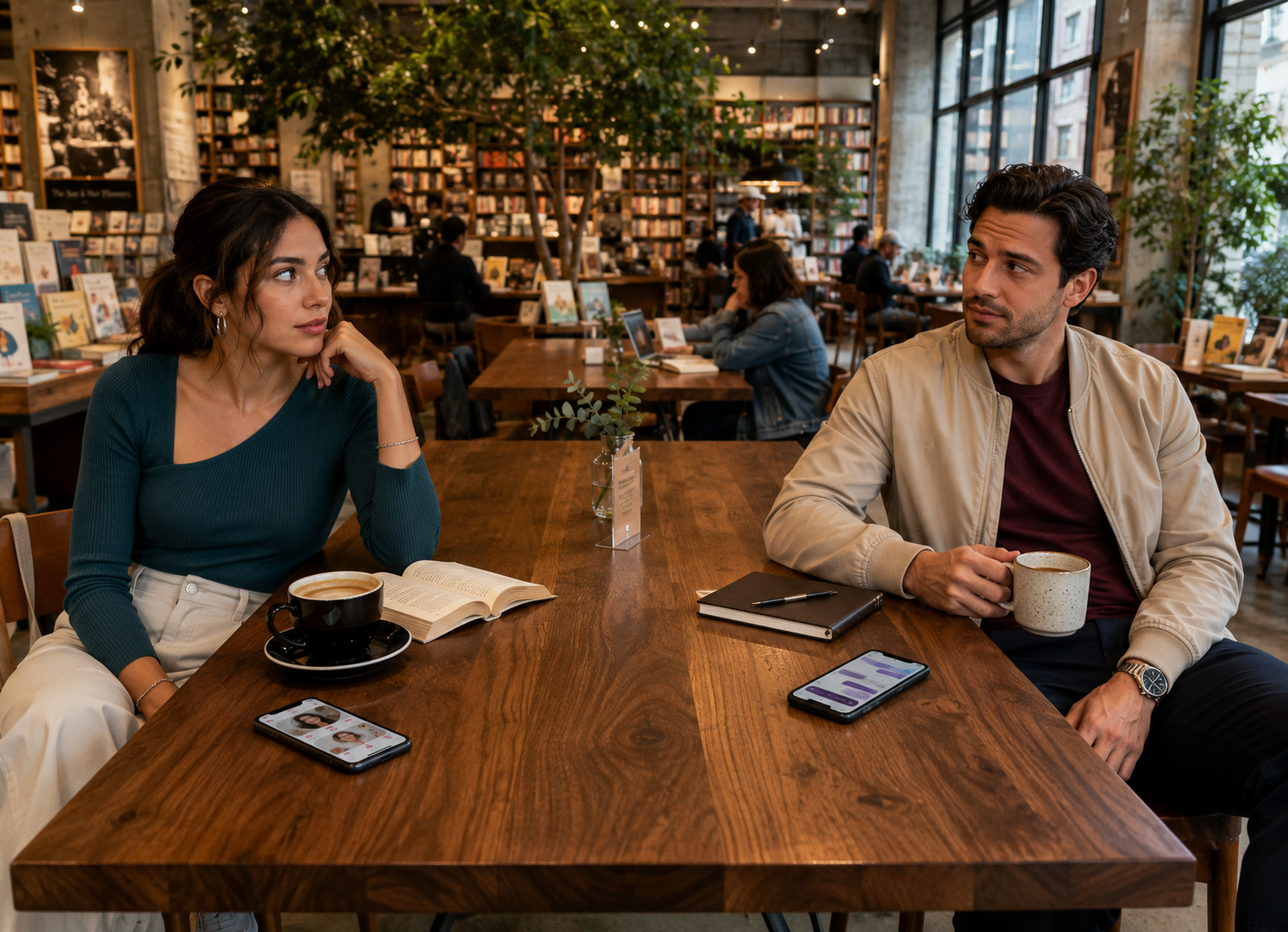
Friday night.
A 27-year-old man is home watching YouTube.
He would like a girlfriend. He has dating apps on his phone. He occasionally matches with someone. But after enough unanswered messages, awkward conversations, expensive first dates, and connections that disappear after a week, staying home feels easier.
Across town, a 26-year-old woman is doing almost the same thing.
She would like a relationship too.
But opening a dating app means sorting through profiles, deciding whom to trust, wondering whether someone’s intentions are genuine, and potentially starting another conversation that never leaves the app.
So she makes dinner, texts a friend, and tells herself:
“Maybe next week.”
Neither person has given up on love.
Neither hates the opposite sex.
Neither necessarily wants to remain single forever.
They’re simply not dating very much.
And increasingly, they aren’t unusual.
A large 2025 U.S. survey of 5,275 unmarried adults ages 22–35 found that only about 30% had gone on a date in the previous month, even though 86% expected to marry eventually. Researchers behind the 2026 State of Our Unions report described the pattern as a “dating recession.”
That creates a fascinating contradiction.
People still want connection.
They still fall in love.
They still imagine relationships, marriage, and families.
But many aren’t doing the activity that traditionally comes before those things:
dating.
So why are men and women dating less?
There isn’t one villain.
It isn’t simply “dating apps ruined everything.”
It isn’t “men stopped trying.”
It isn’t “women became too picky.”
Modern dating has become a complicated mixture of technology, economics, changing expectations, different experiences for men and women, emotional fatigue, safety concerns, and an enormous number of alternatives competing for our attention.
Here are seven reasons dating may feel harder to start—and easier to avoid.
1. Dating Apps Give Men and Women Very Different Problems
Imagine opening a dating app and receiving almost no attention.
You swipe.
Nothing.
You send messages.
Most don’t receive replies.
After enough repetition, you begin wondering whether anyone is interested in you at all.
Now imagine the opposite.
You open the same type of app and have plenty of potential conversations.
But now you have to sort through them.
Who actually wants a relationship?
Who copied that opening line to twelve people?
Who seems safe?
Who is being honest?
Who will become inappropriate the moment you reply?
Too little attention can be discouraging.
Too much low-quality or unwanted attention can be exhausting.
And research suggests men and women can experience these different frustrations on dating platforms.
In Pew Research Center’s U.S. research, 64% of male current or recent online daters said they had at least sometimes felt insecure because of the number of messages they received, compared with 40% of women.
Women reported the reverse problem more often: 54% of women said they had at least sometimes felt overwhelmed by the number of messages they received, compared with 25% of men.
Same technology.
Very different emotional experience.
This helps explain why arguments about whether dating is “easier for men” or “easier for women” usually go nowhere.
Both can struggle.
They’re often struggling with different parts of the system.
For some men, the problem may be getting enough opportunities.
For some women, the problem may be filtering opportunities into ones that actually feel desirable and safe.
Neither experience feels particularly romantic.
2. Swiping Can Start Feeling More Like Work Than Dating
Download an app.
Create a profile.
Choose six photographs.
Write prompts.
Swipe.
Match.
Think of an opening line.
Send it.
Wait.
Reply.
Ask a question.
Receive:
“haha yeah.”
Try again.
Move to texting.
Schedule something.
Someone cancels.
Back to swiping.
At first, dating apps can feel exciting because they dramatically expand the number of people you can potentially meet.
But repetition changes the experience.
Eventually, people can stop feeling like people and start looking like cards in an endless selection interface.
Recent research gives us reason to take the psychological side seriously without claiming apps directly cause poor mental health.
A 2026 systematic review and meta-analysis examined 27 studies involving 21,263 participants and found small-to-moderate associations between swiping-based dating-app use and several mental-health-related outcomes, including emotional distress, appearance concerns, body-image disturbance, behavioral dysregulation, and interpersonal sensitivity. The researchers emphasized that the existing evidence cannot establish the mechanisms behind those associations.
Another 2026 meta-analysis examining 23 studies and more than 26,000 participants similarly found an association between dating-app use and poorer psychological health and well-being, while warning that much of the evidence is cross-sectional and therefore cannot establish causation.
That’s an important qualification.
We shouldn’t conclude:
Dating apps make everyone miserable.
Plenty of people meet partners through them. Pew found that 20% of partnered Americans under 30 said they met their current partner through an online dating site or app.
Apps clearly can work.
But a tool can be useful and tiring at the same time.
And after enough repetitive swiping, matching, disappearing conversations, and restarting, taking a break can begin to feel more attractive than finding another match.
3. Men and Women May Enter Dating With Different Expectations
Two people match.
Both are attracted to each other.
Both agree to meet.
That doesn’t mean they’re looking for the same thing.
One wants a committed relationship.
The other is open to commitment but also happy to date casually.
One expects regular communication.
The other thinks texting twice a week is perfectly normal.
One wants exclusivity after a few months.
The other doesn’t want labels.
Neither preference is automatically wrong.
But modern dating allows people with dramatically different goals to meet in the same places.
Pew’s research found meaningful gender differences among single Americans who were actively looking for romance.
Among those looking, 41% of women said they were interested only in a committed romantic relationship, compared with 25% of men. Meanwhile, men who were looking were more likely than women to say they were open to either casual dates or a committed relationship.
This doesn’t mean:
Women want commitment and men don’t.
Plenty of men want serious relationships, and plenty of women don’t.
It means averages can hide an important dating problem:
Two people can both be “looking” while looking for different things.
That creates more filtering.
More conversations about intentions.
More ambiguity.
More connections that initially appear promising but eventually reveal incompatible goals.
After enough experiences like that, someone may not stop wanting love.
They may simply become much more cautious about investing in another stranger.
4. Dating Has Become Financially Harder to Justify
Dating isn’t supposed to be a financial transaction.
But dating costs money.
Dinner.
Drinks.
Coffee.
Transportation.
Parking.
Tickets.
New clothes.
Babysitting for parents.
Ride-share costs.
And if you’re dating regularly, those expenses accumulate.
This matters more when housing, groceries, transportation, and other everyday expenses already consume a large part of someone’s income.
The financial question can also become gendered.
Traditional dating expectations haven’t disappeared simply because society has changed.
Some men still feel pressure to pay, particularly during early dates.
Some women prefer splitting expenses.
Others interpret someone’s willingness to plan and pay as part of courtship.
There is no universal rule anymore—which can itself create uncertainty.
Recent commentary around Gen Z dating has increasingly focused on this tension: young adults may want romance while feeling that conventional date formats are unnecessarily expensive.
But the deeper issue isn’t whether coffee costs $6 or dinner costs $100.
It’s opportunity cost.
Imagine you’re already financially stressed.
Do you spend money meeting someone you’ve exchanged twelve messages with?
Or do you spend Friday night with friends you already know you’ll enjoy?
Dating asks people to invest resources into uncertainty.
When money feels tight, uncertainty becomes harder to justify.
That doesn’t mean romance disappears.
It may simply change form.
Walks.
Coffee.
Free museums.
Parks.
Cooking together.
Community events.
Dating doesn’t need luxury.
But when people unconsciously equate “real dating” with expensive experiences, financial pressure can quietly reduce how often they participate.
5. Women May Have More Safety Concerns to Calculate
A man and woman agree to meet someone from an app.
Both may be nervous.
But their risk calculations aren’t necessarily identical.
Is the location public?
Should I tell a friend where I’m going?
Should I share my live location?
Should they pick me up, or should I meet them there?
How much personal information should I reveal?
What happens if they don’t take rejection well?
These questions can become part of dating before attraction even gets a chance to develop.
Pew found a substantial gender difference in perceptions of online-dating safety. 57% of women said dating sites and apps were not a safe way to meet people, while men were considerably less likely to express that view.
And those concerns don’t exist in a vacuum.
Among people who had used dating sites or apps, Pew found that 48% had experienced at least one of four unwanted behaviors measured in its survey, including unsolicited sexual content, continued unwanted contact, offensive name-calling, or physical threats.
This doesn’t mean women don’t want relationships.
It means the journey toward one can involve an additional layer of evaluation.
A profile isn’t just:
“Am I attracted to him?”
It can also become:
“Does meeting him feel safe?”
When the perceived risk of dating increases, being selective isn’t necessarily evidence that someone has unrealistic standards.
Sometimes caution is rational.
6. Rejection and Disappointment Can Make Men Withdraw Too
Men face another challenge that deserves attention without turning dating into a competition over who suffers more.
In many heterosexual dating contexts, men are still expected to initiate.
Send the first message.
Ask for the number.
Suggest the date.
Make the move.
That means some men encounter rejection repeatedly before a relationship even begins.
One rejection isn’t catastrophic.
Neither are five.
But repeated low response rates, conversations that disappear, matches that never reply, or dates that go nowhere can gradually change behavior.
Remember the Pew finding:
Among recent online daters, men were substantially more likely than women to report feeling insecure because of the number of messages they received.
There’s another interesting shift.
Pew found that 50% of single men were looking for a relationship or casual dates in 2022, down from 61% in 2019. Among single women, the change over that period was not statistically significant: 35% were looking in 2022 versus 38% in 2019.
That doesn’t prove rejection caused men to withdraw.
It would be irresponsible to make that leap.
But it does show something worth paying attention to:
A meaningful share of single men aren’t actively pursuing dating even when broader cultural assumptions often portray men as constantly searching for romantic or sexual opportunities.
Sometimes withdrawal isn’t:
“I don’t want anyone.”
It may be:
“I’m tired of trying.”
And that’s a very different psychological state.
7. Being Single Has Become a More Complete Life
This may be the most overlooked explanation.
Previous generations didn’t necessarily date more because they were naturally more romantic.
Social structure was different.
Marriage had stronger economic expectations.
Gender roles were more rigid.
Social circles were often more geographically concentrated.
Meeting people offline was unavoidable.
And living independently outside marriage was less socially accepted in many communities.
Today, a single person can build an extraordinarily full life.
Work.
Friends.
Travel.
Streaming.
Gaming.
Fitness.
Pets.
Social media.
Hobbies.
Side businesses.
Online communities.
Food delivery.
Entertainment available instantly.
You can spend an entire weekend alone without experiencing a single empty hour.
That’s both wonderful and complicated.
Relationships now compete with lives that can already be comfortable.
A date isn’t competing only against another romantic option.
It’s competing against:
a quiet evening at home.
And the quiet evening has advantages.
It won’t ghost you.
It won’t reject you.
It won’t arrive 40 minutes late.
It won’t turn out to have completely different intentions.
It won’t make you explain yourself to a stranger.
So modern relationships often have to offer something better than simply not being alone.
That’s probably healthy.
But it raises the threshold for participating in dating at all.
Are Young People Really Dating Less?
There is evidence that many are.
The 2026 State of Our Unions report analyzed a nationally representative 2025 survey of 5,275 unmarried Americans ages 22–35.
Among those surveyed, only about 30% reported going on a date during the previous month.
Even among respondents who expected to marry eventually, dating activity remained relatively low.
That’s why the researchers used the phrase:
“dating recession.”
But we should be careful with dramatic headlines.
“Dating less” doesn’t mean:
Nobody dates anymore.
Nor does it prove modern relationships are doomed.
It means there appears to be a gap between the number of young adults who ultimately want partnership and the number actively dating at a given moment.
And that gap deserves explanation.
Why Are So Many Young Men Single?
This question attracts enormous attention online, usually followed by extremely confident explanations.
But the numbers themselves need context.
Pew reported that 63% of U.S. men under 30 described themselves as single, compared with 34% of women under 30 in its 2022 data.
That difference is real within the survey.
But don’t turn it into:
“Women are all dating the same tiny group of men.”
The data doesn’t establish that.
Age differences between partners, differences in how people define relationship status, survey timing, and other demographic factors can contribute to disparities.
What the number does tell us is simpler:
Young men’s experience of singleness deserves serious attention.
Mocking lonely men isn’t useful.
Blaming women isn’t useful either.
If people are struggling to form relationships, the useful questions involve social confidence, economic circumstances, friendship networks, opportunities to meet people, mental well-being, expectations, and communication.
Gender wars generate clicks.
They don’t generate many healthy couples.
Are Women Giving Up on Dating?
Some are taking breaks.
Some are dating very selectively.
Some are actively searching.
Some are happy single.
Some desperately want a relationship.
There is no single female dating experience.
But the available research does suggest that single women are less likely than single men to say they’re currently looking for romance.
In Pew’s 2022 data, 35% of single women said they were looking for a committed relationship and/or casual dates, compared with 50% of single men.
That doesn’t automatically mean women “need men less.”
A person may want partnership eventually while not wanting to participate in dating right now.
Those are different questions.
Someone can think:
“I’d love to meet the right person.”
while simultaneously thinking:
“I don’t want to go on another app date this month.”
That’s essentially the contradiction at the heart of the dating recession.
Dating Apps Aren’t the Whole Problem
It’s tempting to blame everything on apps.
Delete them and dating will magically return to normal.
Probably not.
Apps amplify certain problems:
choice overload,
appearance-based evaluation,
repetitive rejection,
unwanted attention,
and ambiguous intentions.
But removing them doesn’t automatically create thriving offline social lives.
You still need somewhere to meet people.
That’s becoming harder for some adults.
Many people work remotely.
Entertainment happens at home.
Friends move to different cities.
Communities become less interconnected.
People spend enormous amounts of leisure time on screens.
You can’t meet someone across the room if nobody goes into the room.
Dating apps partly became powerful because they solved a real problem:
How do adults find other available adults?
So the future of dating probably isn’t simply:
apps vs. real life.
It’s finding healthier ways for digital introductions and real-world social environments to coexist.
Men and Women Aren’t Enemies in the Dating Recession
Open almost any discussion about modern dating and eventually you’ll see two arguments.
Men are the problem.
Then:
Women are the problem.
Both are emotionally satisfying explanations because they give frustration a villain.
Neither explains reality very well.
Men can struggle with loneliness, rejection, confidence, lack of matches, expectations to initiate, and uncertainty about what modern courtship should look like.
Women can struggle with unwanted attention, safety concerns, harassment, emotional labor, incompatible intentions, and exhaustion from filtering potential partners.
Both can experience:
ghosting,
situationships,
dating burnout,
financial pressure,
fear of rejection,
unrealistic expectations,
and the strange feeling that thousands of potential partners exist while genuine connection remains difficult to find.
Modern dating doesn’t need another gender war.
It needs better understanding of why two groups of people who often want each other can have such a difficult time finding each other.
What Could Make Dating Better?
Probably not another list of manipulative dating rules.
Wait exactly three hours before replying.
Never double text.
Act unavailable.
Make them jealous.
Never show too much interest.
Don’t define the relationship too early.
Don’t care too much.
Those strategies can make dating feel even more like a game nobody enjoys playing.
A healthier dating culture would probably involve something less exciting:
clarity.
If you want a relationship, say so.
If you only want something casual, say that too.
If you aren’t interested, reject someone respectfully instead of keeping them around for attention.
If you like someone, occasionally allow yourself to look like you like them.
Choose affordable dates if money is tight.
Move promising online conversations into safe real-world meetings instead of messaging for six weeks.
And remember that the person across from you is probably carrying their own dating frustrations too.
Not every man is trying to use women.
Not every woman is waiting for someone better.
Most people are considerably more complicated than the algorithms discussing them.
If You’re Tired of Dating, Taking a Break Is Okay
Dating burnout is real as an experience even when it doesn’t have a formal diagnostic label.
If every swipe annoys you, every conversation feels identical, and every date feels like an obligation, taking a break may be healthier than forcing yourself to continue.
Delete the apps for a while if you need to.
See friends.
Exercise.
Travel.
Work on something meaningful.
Spend time in environments where you naturally meet people without evaluating everyone as a romantic candidate.
But distinguish between:
taking a break
and
building permanent avoidance around disappointment.
If you ultimately want a relationship, at some point you’ll probably have to accept one unavoidable feature of dating:
uncertainty.
You cannot guarantee that someone will like you.
You cannot guarantee that the third date becomes a relationship.
You cannot guarantee that a relationship lasts.
Dating requires risking some disappointment.
The goal isn’t eliminating that risk.
It’s making the process worthwhile enough that people are willing to try.
Why Are Men and Women Dating Less? The Bottom Line
Men and women haven’t suddenly stopped wanting love.
That’s what makes the current dating landscape so interesting.
Many young adults still expect partnership or marriage eventually, yet a much smaller share are actively dating at any particular moment.
Why?
Because dating now asks people to navigate several pressures simultaneously.
Men may encounter repeated rejection, low response rates, uncertainty about initiation, and financial expectations.
Women may face overwhelming attention, safety calculations, harassment, and the work of filtering incompatible intentions.
Both encounter dating-app fatigue, ambiguous relationships, financial pressure, endless choice, disappointment, and increasingly comfortable alternatives to dating.
Technology gave us access to more potential partners than previous generations could have imagined.
It didn’t automatically make connection easier.
And perhaps that’s the strangest part of modern romance.
A man can have thousands of women theoretically available on his phone and feel like nobody wants him.
A woman can have hundreds of men theoretically available and feel like none of those options offers what she’s actually looking for.
Abundance can still feel lonely.
The solution probably isn’t men lowering every standard.
It isn’t women lowering every standard.
And it certainly isn’t convincing either gender that the other is the enemy.
Maybe modern dating improves when people stop treating relationships like an adversarial marketplace and remember what they’re actually trying to find:
one person they genuinely like who genuinely likes them back—and two people willing to do something real about it.
Sources & Research
- Hawkins, A. J., Willoughby, B. J., Carroll, J. S., & Wilcox, B. (2026). State of Our Unions 2026: The Dating Recession. The report draws on the 2025 National Dating Landscape Survey, a nationally representative sample of 5,275 unmarried U.S. adults ages 22–35.
- Cela, H., & Wood, G. (2026). A systematic review and meta-analysis of the mental health correlates of swiping-based dating app use. Communications Psychology. The analysis synthesized 27 studies involving 21,263 participants.
- Sharabi, L. L., Ou, L., Von Feldt, P. A., & Parsons, T. D. (2026). Dating app use, psychological health, and psychological well-being: A systematic review and quantitative meta-analysis. Computers in Human Behavior. The review included 23 studies and more than 26,000 participants.
- Pew Research Center (2023). From Looking for Love to Swiping the Field: Online Dating in the U.S. A nationally representative study examining dating-app use, gender differences, safety, unwanted behaviors, messaging experiences, and relationship goals.
- Pew Research Center (2023). 5 Facts About Single Americans for Valentine’s Day. Research examining singleness, relationship-seeking, and differences between single men and women.











Leave a Reply