

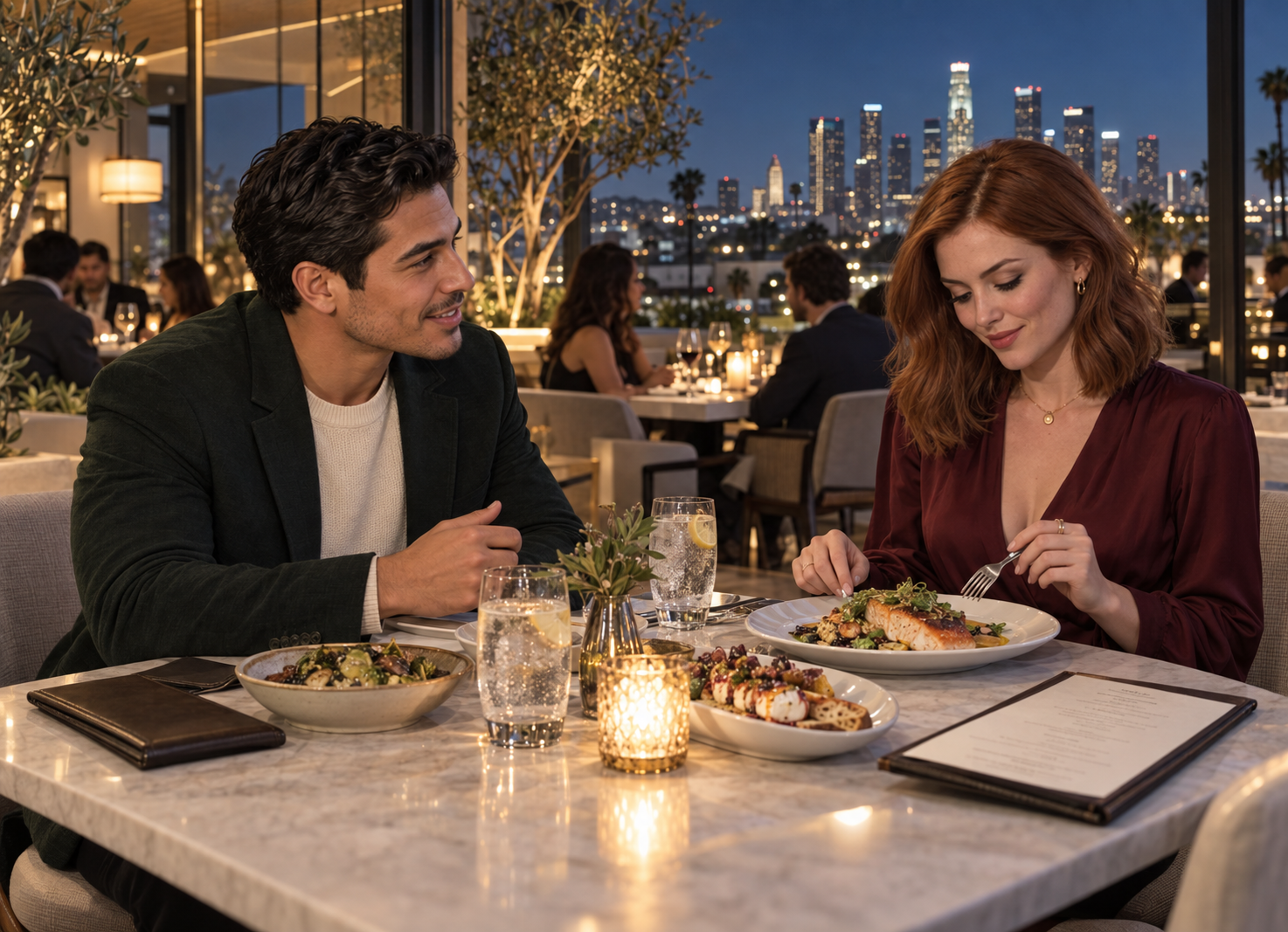
The conversation is going well.
They seem interested.
Then you suggest coffee.
Suddenly the enthusiasm drops.
“How about that new steakhouse instead?”
You agree.
Dinner is fantastic. The cocktails arrive. Then dessert.
You pay.
The next morning?
Silence.
Was it simply a date that didn’t work out?
Maybe.
Or you may have experienced what internet dating culture calls a foodie call.
And apparently, it is not particularly rare.
A July 2026 DatingAdvice survey of 1,016 U.S. adults found that 30% said they had accepted a romantic dinner invitation primarily for free food or drinks rather than genuine romantic attraction. The percentage was 32% among women and 26% among men.
Even more surprisingly, the behavior was not limited to broke college students or Gen Z dating-app users.
At least one-quarter of respondents in every reported age group said they had done it.
So, are American singles suddenly dating for dinner instead of romance?
Not exactly.
The truth is more complicated—and considerably more interesting—than “people are using each other for free food.”
Table of Contents
What Is a Foodie Call?
A foodie call is a date someone accepts primarily because they expect to receive free food or drinks, despite having little or no genuine romantic interest in the person inviting them.
The term plays on “booty call,” except the desired outcome is dinner rather than sex.
Researchers gave the concept a more formal definition in a study first published online in 2019 and later appearing in Social Psychological and Personality Science.
Their version focused on a particularly deceptive scenario: a woman who lacked romantic attraction toward a man but intentionally represented herself as interested so she could dine at his expense.
That distinction matters.
Accepting dinner from someone who offered to pay is not automatically a foodie call.
Neither is going on a date when you are genuinely uncertain whether attraction will develop.
The defining issue is motivation.
Consider three situations.
Situation A:
“I’m attracted to him and would like to know him better. He invited me to dinner.”
Normal date.
Situation B:
“I’m not sure whether I’m attracted yet, but I’m curious enough to give the date a chance.”
Also normal dating.
Situation C:
“I know I’m not interested in him, but that restaurant is expensive and he’s paying.”
Now we are in foodie-call territory.
Where Does the “30% of Americans” Number Come From?
This is where precision matters.
You may see headlines saying:
“30% of Americans date for free food.”
That sounds as though researchers discovered that nearly one-third of the country is secretly running a dinner-based romance scam.
The actual evidence is narrower.
DatingAdvice conducted an online-panel survey of 1,016 U.S. adults, with an overall reported margin of error of approximately ±3.1 percentage points at the 95% confidence level.
Thirty percent of respondents reported having accepted a date primarily for free food or drinks.
So the responsible takeaway is:
About 30% of adults in this particular U.S. survey said they had done it at least once.
That is not the same as proving exactly 30% of every American dater behaves this way.
Still, it is a striking result.
Especially because it aligns with earlier research showing foodie calls are not merely an internet joke.
Researchers Were Studying Foodie Calls Years Before TikTok Made Everything a Dating Trend
The first major academic study of foodie calls surveyed heterosexual women.
Researchers Brian Collisson, Jennifer Howell, and Trista Harig conducted two studies and found that approximately 23% of women in one sample and 33% in another reported previously engaging in a foodie call.
That is where the familiar “about one-third” figure originally entered popular dating coverage.
But the researchers themselves issued an important warning.
Their samples were not representative samples of women generally, meaning the percentages could not simply be projected onto every American woman.
That caveat often disappeared once the finding reached headlines.
Then things became even more interesting.
A Later Study Found 52.8% of Its U.S. Women Reported Foodie Calls
A registered cross-cultural replication, published in Psychological Reports in 2025 after appearing online earlier, surveyed heterosexual women in the United States, United Kingdom, and Poland.
Among 983 women in the U.S. sample, 52.8% reported previously engaging in a foodie call.
That was dramatically higher than the 23% and 33% observed in the original studies.
But before declaring that half of American women are secretly eating through Tinder, there is another important lesson:
Different studies can produce very different prevalence estimates depending on sampling, question wording, participants, culture, and methodology.
The safest conclusion is not:
“Exactly X percent of people do this.”
It is:
Foodie calls appear to be a real dating behavior reported by a meaningful minority of people, but their exact prevalence remains uncertain.
That is considerably less exciting than a viral statistic.
It is also considerably more accurate.
And No, Foodie Calls Aren’t Just Something Women Do
The original academic research focused specifically on heterosexual women accepting meals from men.
That design made sense for the researchers’ question, but it created an unfortunate side effect.
Online discussions frequently transformed:
“Researchers studied women”
into:
“This is a female behavior.”
Those are not the same statement.
The researchers explicitly acknowledged that foodie calls could occur across genders and different types of relationships.
The newer 2026 DatingAdvice survey supports that broader interpretation.
It found:
32% of women reported the behavior.
But so did 26% of men.
That six-point difference is worth noting.
It is not evidence that one gender invented using dates for freebies while the other sits innocently across the table.
Modern dating conversations already have enough gender warfare.
Jiggle X Wiggle’s look at men and women’s dating standards in 2026 reaches a similar conclusion: men and women sometimes approach dating differently, but social-media arguments routinely exaggerate those differences into opposing teams.
Foodie calls are better understood as a behavior than as a gender identity.
Why Would Someone Go on a Date Just for Free Food?
The obvious answer is:
Because they want free food.
Groundbreaking.
But that answer does not explain much.
People may arrive at the same behavior through very different motivations.
The Completely Opportunistic Foodie Call
This is the cleanest version.
Someone knows they have zero romantic interest.
They would not meet the person for coffee.
They would not take a walk with them.
They would not spend two hours talking if nothing were being provided.
But:
“Omakase?”
Suddenly they’re available Friday.
This is closest to the deceptive behavior examined in the original research.
The “Maybe I Like Them, But the Restaurant Helped” Date
This is much grayer.
Suppose someone is only mildly interested.
They think:
“I’m not sure about him, but he seems nice.”
Then he suggests the restaurant they have wanted to try for months.
Now they say yes.
Did the meal influence the decision?
Absolutely.
Was the meal the only reason?
Maybe not.
Real-life motivations are rarely as clean as survey questions.
Dating regularly involves mixtures of:
curiosity,
attraction,
boredom,
loneliness,
social pressure,
attention,
hope,
convenience,
and yes, sometimes an excellent plate of pasta.
A person can be genuinely uncertain about attraction and still be dating in good faith.
Dating Is Expensive Enough That the Free Dinner Has Become More Valuable
There is also an economic backdrop that should not be ignored.
Dating in the United States is expensive.
A February 2026 BMO survey estimated an average all-in date cost of $189, including expenses such as transportation and pre-date preparation. Respondents reported spending an average of $2,323 on dates over the previous year, while nearly half of singles said dating was not financially worth the cost.
Official inflation data provides additional context.
The U.S. Bureau of Labor Statistics reported that food away from home prices were 3.4% higher in July 2026 than a year earlier.
That does not prove expensive restaurants cause foodie calls.
The 2026 DatingAdvice survey also cannot establish that.
But the economics make the appeal easier to understand.
Dinner for two at a decent restaurant can quickly become:
entrées,
drinks,
tax,
tip,
parking,
Uber,
and perhaps dessert.
Dating can turn one mediocre evening into a three-digit financial experiment.
That financial pressure is part of the larger reason men and women are dating less in the first place: the cost of meeting people now sits alongside app fatigue, rejection, uncertainty, safety concerns, and emotional burnout.
The West Reported More Foodie Calls Than the Midwest
The 2026 survey produced another interesting pattern.
Respondents in the Western United States reported the highest foodie-call rate at 35%.
The reported figures were:
- West: 35%
- South: 30%
- North: 26%
- Midwest: 22%
DatingAdvice noted that higher living costs in Western cities could potentially contribute to the pattern, but its survey could not establish causation.
That last part is important.
It is tempting to look at:
expensive region + more foodie calls
and conclude:
expensive region causes foodie calls.
Maybe economic pressure contributes.
Maybe dating norms differ.
Maybe the sample differed in other ways.
Good research reporting sometimes ends with:
“We don’t know yet.”
This is one of those cases.
Gen Z Didn’t Invent Foodie Calls Either
You might expect foodie calls to be another bizarre artifact of swipe culture.
Apparently not.
The 2026 survey found that Gen Z and younger millennial/zillennial respondents ages 28–33 were among the highest-reporting groups at 32%.
But adults ages 65 and older were not dramatically behind.
About 26% of respondents 65+ also said they had gone on a date primarily for free food or drinks.
At least one-quarter of every reported age group admitted the behavior.
So blaming Tinder does not work particularly well here.
People apparently discovered the strategic benefits of dinner invitations long before swiping existed.
Technology may change how dates are arranged.
Human opportunism is considerably older.
What About the “Dark Triad” Claim?
This is where foodie-call coverage can become unfair very quickly.
The original study found that women who scored higher on measures associated with the Dark Triad—narcissism, Machiavellianism, and psychopathy—were more likely to report foodie-call behavior and view it as acceptable.
Traditional gender-role beliefs also predicted the behavior in the first study.
You may therefore see articles suggesting:
“If someone accepts a free dinner without liking you, they’re probably a narcissist or psychopath.”
Do not make that leap.
The later registered replication found that the general Dark Triad factor did not significantly predict foodie-call behavior across the pooled sample in the same way.
Within the U.S. sample, the original Dark Triad pattern largely failed to replicate; only narcissism showed a relationship with foodie-call behavior, while traditional gender-role beliefs were more relevant to perceived acceptability.
That is exactly why one behavior should not become an internet diagnosis.
Someone can behave selfishly without having a personality disorder.
Someone can also accept an expensive dinner for bad reasons without fitting a psychological label you learned from TikTok.
Call the behavior what it is.
You do not need to diagnose the diner.
Traditional Dating Rules Create the Perfect Gray Area
Foodie calls also exist inside a much older debate:
Who should pay for the first date?
Traditional heterosexual dating norms often expect men to pay.
Surveys still find plenty of Americans holding that expectation.
A LendingTree study found that 44% of Americans said the man should pay on a heterosexual first date, while 25% said whoever initiated the date should pay.
Now combine:
one person expected to pay,
another person uncertain about attraction,
an expensive dinner,
and no explicit conversation about the bill.
You have a perfect environment for resentment.
The payer may think:
“I’m investing in a potential relationship.”
The other person may think:
“They invited me. Of course they’re paying.”
Neither assumption necessarily means someone is exploiting anyone.
The ethical problem appears when someone knowingly manufactures romantic interest specifically to obtain the benefit.
That is very different from simply allowing your date to pay.
Is Going on a Foodie Call Actually Wrong?
There is a simple test.
Remove the free meal.
Would you still go?
If the honest answer is:
“Absolutely not,”
and you are intentionally presenting romantic interest you do not feel because you want someone else to buy dinner, then yes, there is a deception problem.
The issue is not the hamburger.
It is the false premise.
Dating involves uncertainty.
Nobody can promise attraction.
Nobody owes someone a second date because dinner cost $150.
Paying does not purchase romance.
But basic honesty still matters.
If one person thinks:
“We’re both here exploring a possible romantic connection,”
while the other thinks:
“I just need to keep this believable until the check arrives,”
they are participating in two different events.
A Bad First Date Is Not Evidence of a Foodie Call
Be careful here.
Someone not wanting a second date does not prove they used you.
People are allowed to discover during dinner that they are not attracted.
People are allowed to:
change their minds,
lose interest,
feel no chemistry,
notice incompatibility,
or simply decide not to continue.
Dating would become impossible if accepting someone’s dinner invitation created an obligation to continue romantically.
This distinction is essential.
Otherwise “foodie call” becomes an easy way to reinterpret rejection:
“She didn’t want a second date, so obviously she only wanted free food.”
Maybe.
Or maybe the date simply didn’t work.
Both possibilities exist.
Signs Someone Might Be More Interested in the Meal Than You
No single sign proves anything.
But certain patterns may justify paying closer attention.
For example:
- they reject simple dates but enthusiastically accept expensive restaurants
- they repeatedly push the date toward pricier venues
- conversation shows very little curiosity about you
- they appear highly engaged with ordering but barely engaged with connecting
- they repeatedly accept costly dates while avoiding any progression in the relationship
- they disappear after expensive outings and return primarily when another one is offered
- they become irritated when splitting the check or choosing an inexpensive date is suggested
Again:
None of these alone proves a foodie call.
Someone can love restaurants and still genuinely like you.
Someone can prefer dinner dates.
Someone can expect traditional courtship.
Someone can be awkward and bad at asking questions.
Look for patterns, not courtroom evidence.
That same principle applies when figuring out whether a connection is actually becoming something. The difference between genuine romantic development and indefinite ambiguity is explored more deeply in Situationship vs Relationship: How to Know What You’re Really In.
The Easiest Way to Avoid a Foodie Call Is Surprisingly Simple
Stop making first dates financially impressive.
Make them conversationally useful.
Coffee.
Ice cream.
A relaxed drink.
A farmers market.
A museum.
A walk through a busy public area.
Casual lunch.
Bookstore plus coffee.
Something that lets two people determine:
“Do we actually enjoy each other?”
before either person invests heavily.
This also fits the logic behind slow dating: early dating becomes more useful when the goal is learning about the person rather than immediately performing romance at maximum intensity.
The 2024 LendingTree survey found 67% of daters said they would not be offended by a date that cost nothing.
So if your $12 coffee suggestion destroys the connection before it begins, you may have learned something extremely useful for only $12.
Possibly less.
Cheap Dates Are Not Low-Effort Dates
This distinction deserves more attention.
Expensive:
$180 dinner where both people stare at their phones.
Thoughtful:
walking through a night market because your date told you they love trying unusual desserts.
Cost and effort overlap sometimes.
They are not synonyms.
A cheap date can show:
planning,
attention,
creativity,
and genuine interest.
An expensive date can require nothing except a credit card.
That is partly why the movement back toward more organic offline interaction is interesting. Jiggle X Wiggle’s look at SABSing and Gen Z’s attempt to meet people in real life again notes an underrated advantage of meeting organically: you can establish whether there is any chemistry before turning the interaction into an expensive formal date.
Meet.
Talk.
Like each other.
Then decide where to eat.
Revolutionary.
Should You Split the Bill to Prevent Foodie Calls?
You can.
But there is no universal dating law requiring it.
Some people prefer:
splitting 50/50.
Others believe whoever invites should pay.
Some couples alternate.
Some men genuinely enjoy paying.
Some women genuinely enjoy paying.
Some people follow traditional gender norms.
The better approach is not:
“Everyone must split every first date.”
It is:
Do not spend more than you can comfortably lose on a date with someone you barely know.
A first date is not a venture-capital round.
You do not need to deploy maximum resources before discovering whether you enjoy a conversation together.
Choose something comfortably affordable.
Then if you pay and nothing develops, you can think:
“That didn’t work.”
instead of:
“I just lost $280.”
If You Realize You Were Used for a Meal, What Should You Do?
Probably less than your angry group chat will suggest.
Do not demand reimbursement because someone rejected you.
Do not publicly shame them.
Do not launch a social-media investigation.
And definitely do not decide an entire gender is responsible.
If someone clearly admits:
“I never liked you. I just wanted dinner,”
you have useful information.
Stop dating them.
If the pattern is merely suspicious, you may never know for certain.
That is frustrating.
But dating contains unavoidable uncertainty.
Your job is not to prosecute every disappointing date.
It is to build a dating strategy where disappointing dates cost less emotionally and financially.
Choose reasonable early dates.
Communicate.
Watch behavior over time.
Let investment grow as the connection grows.
If You’re Tempted to Go on a Foodie Call Yourself
Try one question:
Would I still meet this person if we were getting coffee and paying separately?
Yes?
Go.
You may be genuinely curious.
No?
Decline.
Free sushi is not worth unnecessarily misleading somebody.
There is also another possibility:
Maybe you genuinely want to date but cannot comfortably afford the dating culture around you.
That problem is real.
The solution does not have to be deception.
Say:
“I’d love to meet. Could we do coffee instead?”
Or:
“I’m trying to keep things inexpensive right now. Want to grab something casual and take a walk?”
Someone genuinely interested in knowing you probably does not require a tasting menu as an entrance fee.
Foodie Calls Reveal Something Bigger About Modern Dating
The funny part of foodie calls is obvious.
People dating for tacos.
People swiping for steak.
Romance sponsored by appetizers.
But underneath the joke is a serious modern-dating tension.
Dates now carry multiple expectations at once.
You are evaluating attraction.
Safety.
Compatibility.
Lifestyle.
Money.
Gender roles.
Effort.
Intentions.
Who asked whom.
Who pays.
Whether there should be another date.
And all of that may happen before the entrées arrive.
At the same time, dates are becoming expensive enough that money affects who goes out, how often they date, and what activities they choose.
BMO’s 2026 research found half of Americans surveyed had reduced dating frequency or chosen cheaper activities because of rising costs, while 47% of singles questioned whether dating was financially worthwhile.
So foodie calls sit at the intersection of three things modern dating is already struggling with:
money, expectations, and honesty.
That makes the trend more revealing than it first appears.
A Free Dinner Isn’t the Real Problem
Nobody owes you attraction because you bought them dinner.
Nobody owes you a second date.
Nobody owes you sex.
Nobody even owes you an explanation for why chemistry disappeared.
But people entering romantic situations do owe each other a reasonable level of honesty.
That is the useful dividing line.
If you genuinely think:
“Maybe there’s something here,”
go have dinner.
If afterward you realize:
“Nope.”
That is dating.
But if you know before leaving home that you would never consider the person romantically and your only thought is:
“I wonder if they’ll order appetizers,”
you are no longer exploring a connection.
You are making a reservation with extra steps.
And considering how expensive dating has become, perhaps the healthiest response to foodie-call culture is not paranoia.
It is making early dates simpler.
Spend less.
Talk more.
Let expensive experiences come later, when both people have given you a reason to believe they actually want to be at the table together.
Frequently Asked Questions
What is a foodie call in dating?
A foodie call is a date someone accepts primarily to receive free food or drinks despite having little or no genuine romantic interest in the person inviting them. The term has been used in academic relationship research as well as popular dating culture.
Is it true that 30% of Americans go on dates for free meals?
A 2026 DatingAdvice online-panel survey of 1,016 U.S. adults found that 30% reported accepting a romantic date primarily for free food or drinks. That is a finding from one survey and should not be interpreted as proof that exactly 30% of all Americans behave this way.
Do women go on foodie calls more than men?
In the 2026 survey, women reported foodie calls somewhat more often than men, at 32% versus 26%. Earlier academic research focused specifically on heterosexual women, so those studies cannot tell us the prevalence among men.
Does going on a foodie call mean someone is a narcissist?
No. The original research found associations between foodie-call behavior and Dark Triad traits, but a later registered replication did not reproduce the overall Dark Triad finding in the U.S. sample. One dating behavior is not enough to diagnose someone’s personality or mental health.
How can I avoid being used for a free meal on a first date?
Choose a relatively inexpensive first meeting, such as coffee, lunch, a walk, ice cream, or another low-pressure activity. Pay attention to whether the person shows genuine curiosity and interest rather than evaluating them based on whether they agree to a costly dinner.
Is accepting a free dinner wrong if you are unsure whether you like the person?
Not necessarily. Dating exists partly to discover whether attraction and compatibility are present. The ethical issue is deliberately pretending to have romantic interest when you already know you are uninterested and are attending primarily to receive a financial benefit.
Research & Sources
- DatingAdvice — 30% of Daters Say the Free Meal Was the Main Attraction
July 29, 2026 survey of 1,016 U.S. adults examining foodie calls by age and U.S. region, with a reported overall margin of error of approximately ±3.1 percentage points.
DatingAdvice foodie-call survey - Collisson, Howell & Harig — Foodie Calls: When Women Date Men for a Free Meal (Rather Than a Relationship)
Peer-reviewed research first published online in 2019 and later appearing in Social Psychological and Personality Science. Two samples found 23% and 33% of surveyed heterosexual women reported foodie calls.
Original Social Psychological and Personality Science study - Society for Personality and Social Psychology — Foodie Calls Research Release
Useful methodological context for the original research, including researchers’ warning that their samples were not representative enough to estimate prevalence among women generally.
SPSP research summary - Orhan et al. — Comparing Foodie Calls in Poland, the United Kingdom, and the United States
Registered replication published in Psychological Reports. The U.S. sample reported much higher foodie-call prevalence than the original study while failing to reproduce the original overall Dark Triad finding in the United States.
PubMed record for the registered replication - BMO Real Financial Progress Index — Date-Flation Hits Hard
2026 survey on American dating expenses reporting an estimated $189 average all-in date spend and financial pressure affecting dating behavior.
BMO 2026 dating-cost research - U.S. Bureau of Labor Statistics — Consumer Price Index, July 2026
Official U.S. inflation data showing food-away-from-home prices increased 3.4% over the 12 months ending July 2026.
BLS July 2026 CPI report - LendingTree — Inflation and Dating Habits
Survey research on first-date payment expectations, dating costs, financial pressure, and Americans’ willingness to choose free dates.
LendingTree dating-cost survey









Leave a Reply